Understanding CFM, Pa and dBA at a Glance
When choosing a fan, never judge performance solely by maximum nominal figures. What truly counts is how these parameters perform within your actual equipment. Below are the three most frequently referenced core metrics: airflow (CFM), static pressure (Pa) and noise (dBA). This condensed quick-reference guide covers definitions, measurement units, real-world implications, practical selection workflows and acceptance checklists to help you fully grasp all key knowledge at once.
I. Overview of the Three Core Parameters (Learn the Basics First)
Airflow – CFM / m³/min
Definition: The volume of air displaced by a fan per unit time (CFM = cubic feet per minute).
Practical implication: Determines heat removal capacity. Larger air volume enables faster heat exchange (though sufficient static pressure is required to support effective airflow).
Static Pressure – Pa / mmH₂O
Definition: A fan's ability to overcome system resistance (caused by filters, heat sinks, pipe bends, air ducts and other obstructions), commonly measured in Pascals (Pa) or millimeters of water column (mmH₂O).
Practical implication: Governs whether air can flow through the entire ventilation path. Insufficient static pressure will severely reduce actual airflow, consumed by system resistance.
Noise – dBA
Definition: A-weighted sound pressure level, a noise metric that matches human auditory perception.
Practical implication: Impacts the comfort of operating environments (low noise is mandatory for office, medical and household equipment). Always pay attention to test prerequisites: measurement distance, background noise and working load conditions.
Simple analogy: Airflow is comparable to "water flow rate", while static pressure is equivalent to "water pump pressure". A pump with high flow but low pressure cannot deliver water to upper floors - the same principle applies to cooling fans.
II. Why Fan Curves Outperform Nominal Ratings
The maximum CFM marked by manufacturers is measured under 0 Pa (zero-resistance) conditions. In real equipment, system resistance is inevitable. For accurate evaluation, you must use the airflow-static pressure curve (Fan Curve). Input your estimated system resistance value (Pa) onto the curve to locate the Work Point: the real CFM, corresponding noise level and power consumption of the fan under your system's operating conditions.
Standard Selection Process: Estimate system resistance (Pa) → Obtain Fan Curve → Locate Work Point → Verify compliance with heat dissipation, noise and service life standards.
III. Relationships Between Parameters: Three Critical Rules to Memorize
1. Higher airflow usually corresponds to higher rotational speed, which in turn generates louder noise.
2. High static pressure cannot be easily achieved by simply increasing power input; it depends on optimized blade and housing design (fan type is the fundamental deciding factor).
3. For high-resistance systems, zero-load nominal CFM is almost irrelevant - only the CFM value at your target static pressure (Work Point airflow) matters.
IV. Typical Fan Types and Their Parameter Priorities (Rapid Screening Reference)
|
Fan Type |
Airflow |
Static Pressure |
Noise (dBA) |
Typical Applications |
|
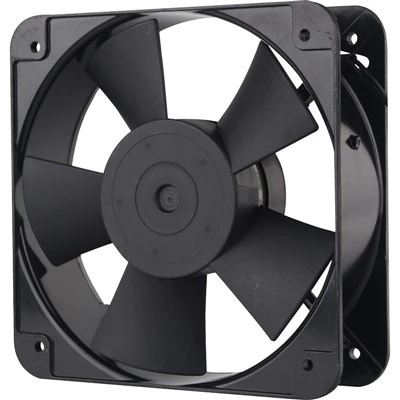
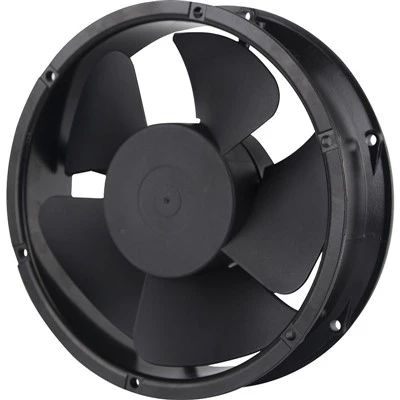
Axial Fan |
High (for high-volume airflow) |
Low (tens of Pa) |
30-60 |
Equipment cabinets, factories, large-volume air exchange |
|
Centrifugal Fan |
Medium |
High (hundreds ~ thousands of Pa) |
40-65 |
Air-conditioning ducts, filtration systems, long air ducts |
|
Blower / Mixed-flow Fan |
Low-to-medium |
Very high (hundreds ~ thousands of Pa) |
35-70 |
Medical equipment, combustion assistance, compact precision-device applications |
Note: The above value ranges are empirical references. Final evaluation shall follow manufacturer fan curves and prototype testing results.
V. Practical Fan Selection: 6-Step Implementation Guide
1. Clarify core requirements: target temperature difference, allowable noise (dBA), supply voltage, operating environment (dust, humidity, high temperature), installation dimensions.
2. Calculate total system resistance (Pa): Sum the pressure drop of air ducts, filters, heat sinks, pipe bends and other components (refer to component pressure drop tables or conduct on-site pressure testing).
3. Acquire airflow-static pressure curves (Fan Curves): Request digital versions from suppliers or product specification sheets.
4. Locate the Work Point: Find the coordinate matching your system resistance on the curve, then read the corresponding CFM, dBA noise and power draw.
5. Confirm service life and bearing type: For 24/7 continuous operation, select ball bearings or liquid bearings, and check the rated service life (in hours).
6. On-site prototype verification: Test temperature reduction, actual airflow, noise and power consumption on physical or simulated air ducts; run the fan continuously for 8–24 hours to monitor stability.
VI. Sourcing Pitfall Avoidance Checklist (Must Confirm Before Placing Orders)
- Provide complete airflow-static pressure Fan Curves.
- Supply CFM, dBA noise and power consumption (W) data under X Pa (your system's operating resistance).
- Specify bearing type and rated service life (hours).
- Confirm compatibility with PWM / temperature-controlled speed regulation (with 3-pin / 4-pin wiring explanations).
- Provide dimension drawings including mounting hole coordinates and wiring instructions.
- Offer prototype samples or on-site testing support.
Do not evaluate fan performance based only on rotational speed or power wattage; blade design and housing structure are the core factors determining static pressure performance.
VII. Noise Selection Standards and Noise Reduction Methods
- Office / medical / household equipment: Target noise ≤ 35 dBA (low-frequency noise components also require assessment).
- Computer rooms / industrial equipment: Higher noise thresholds are acceptable, yet long-term noise exposure and vibration risks need control.
Noise reduction solutions: PWM speed adjustment, acoustic enclosures / damping materials, vibration-dampened mounting brackets, low-frequency optimized structural design.
VIII. Application Matching Examples (Quick On-Site Reference)
1. Communication cabinets / servers: Prioritize high airflow (CFM) → Axial fans; optimize air channel layout to prevent hot air recirculation.
2. Air purifiers / air conditioners with filters: Prioritize high static pressure (Pa) → Centrifugal fans or high-static blowers.
3. Ventilators / medical equipment: Require both high static pressure and low noise → High-grade blowers with stable long service life.
4. Long air ducts / multi-bend pipelines: Prioritize high static pressure (Pa) → Centrifugal fans or series-connected fan layouts (efficiency loss must be evaluated simultaneously).
IX. Acceptance Inspection and Long-Term Maintenance Guidelines
Incoming inspection items: Dimensions, nameplate specifications, actual airflow/static pressure/noise measured at target Pa, power consumption, speed regulation functions.
Short-run acceptance test: Operate the fan connected to equipment for 8–24 hours; monitor bearing temperature rise, vibration and noise fluctuations.
Long-term maintenance: Regularly clean filters and impellers; continuously track bearing temperature and vibration metrics. Develop spare part replacement plans for year-round 24/7 operating equipment.
X. Quick Reference Cheat Sheet (Core Takeaways)
- Airflow (CFM): Total displaced air volume - prioritize for open, low-resistance ventilation systems.
- Static Pressure (Pa): Ability to push air through obstructions - prioritize for systems fitted with filters, heat sinks or long air ducts.
- Noise (dBA): Determines environmental comfort - a key indicator for office and medical scenarios.
- Work Point data is more valuable than zero-load nominal values: Always reference readings extracted from Fan Curves at your operating static pressure.