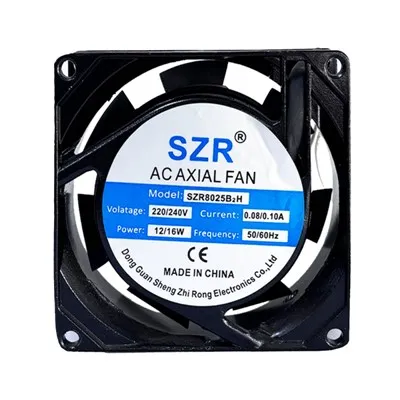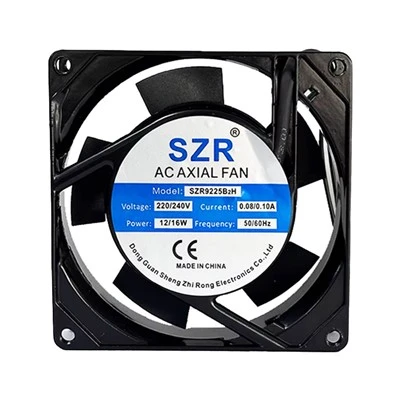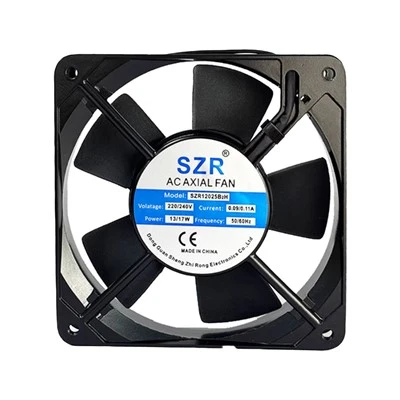
Dongguan Shengzhirong Electronics Co., Ltd. (SZR) was founded in 2003. Starting business in Shenzhen, we completed re-registration and relocated to Dongguan in 2012. We specialize in the R&D, design and manufacturing of heat dissipation products, covering DC fans, AC axial fans, centrifugal fans, chip fans and hundreds of derivative models. We offer customized thermal solutions for equipment. Our products are widely used in communications, industrial control, medical, military and other industries, serving global customers mainly from Europe and America.
Axial Fans: Introduction
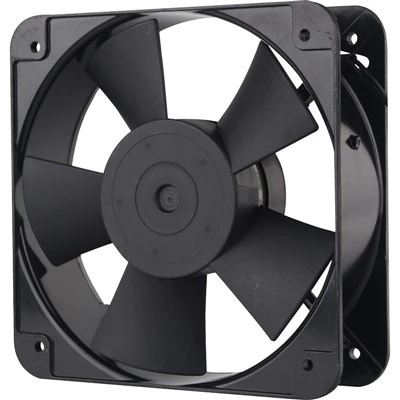
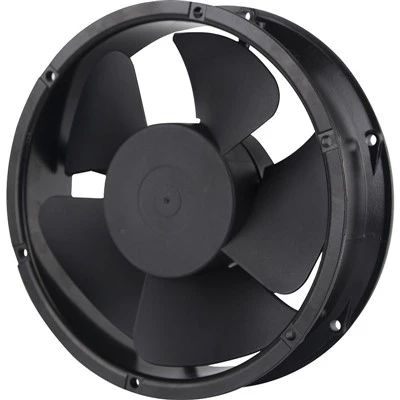
Axial fans produce airflow parallel to the rotating blade shaft and can form pressure differences. Their performance depends on blade shape and blade quantity, and they are commonly used in wind tunnels and cooling towers.
Key Drivers of the Global Axial Fans Market
Axial fans generate high-volume, low-pressure airflow, suitable for cooling confined spaces like server rooms. Standard AC axial fans are energy-efficient, consuming roughly 100 watts at full speed. DC axial fans can be directly powered by batteries and solar panels. Thanks to stable cold airflow output, they are widely equipped in vending machines. Continuous technological innovation of vending machines will further raise market demand for high-quality axial fans.
Classification & Applications of Axial Cooling Fans
Fans are divided into axial flow and radial flow types according to airflow direction. Axial fans push air parallel to the rotation shaft, while radial fans produce airflow perpendicular to the shaft.
Axial fans are grouped into large, medium and small specifications:
Large axial fans: dust exhausting, gravel yards;
Medium axial fans: indoor ventilation and heat dissipation (e.g. granaries);
Small axial fans: cooling for mechanical equipment (e.g. electrical cabinets);
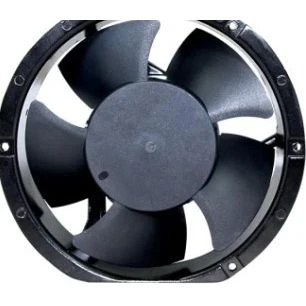
Traditional axial fans have an inherent defect: the motor blocks airflow and creates a central cooling blind zone right above heat-generating core parts, reducing overall heat dissipation efficiency. Centrifugal radial fans were developed to solve this problem.
Axial cooling fans feature a simple structure, stable performance, low noise and rich functional options. They support ventilation and heat dissipation in metallurgy, chemical, light, food, pharmaceutical industries and civil buildings. They can work as bare fans without housings, or be installed in series inside long exhaust ducts to increase wind pressure.
Daily Maintenance & Storage Requirements
Operation
Keep the fan body, air inlet and outlet clean, and regularly remove accumulated dust. Operate the fan only when it works normally. Provide stable and sufficient power via dedicated power lines; long-term use of temporary wires and phase-loss operation are strictly forbidden.
Storage
Store axial fans in dry environments to prevent motor dampness. Take protective measures for outdoor storage. Avoid collisions during handling and storage to prevent damage.