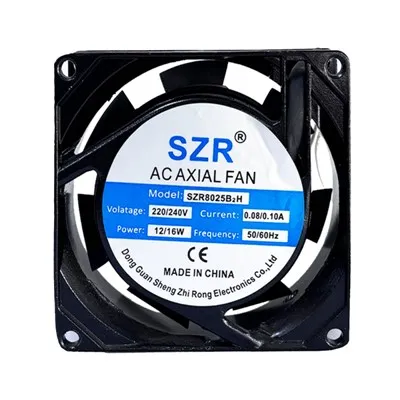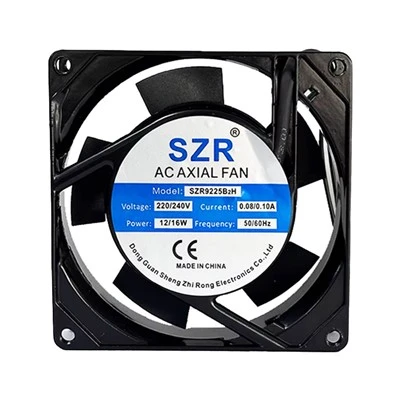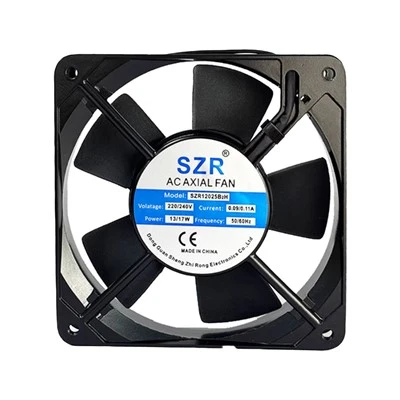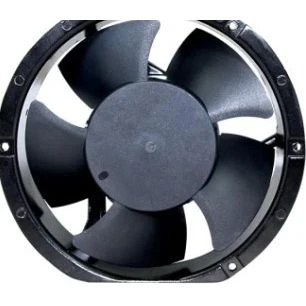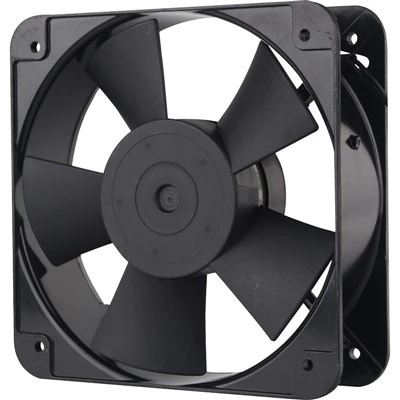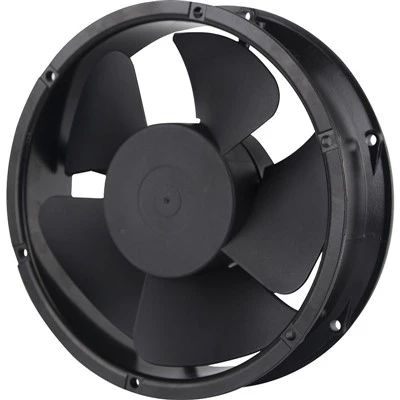
Gas Intake: When the motor starts, it drives the impeller to rotate at high speed. At this time, the gas at the inlet is drawn into the fan due to the negative pressure effect generated by the impeller rotation. During this process, the gas velocity and pressure are relatively low, and the airflow is mainly formed by the rotational kinetic energy of the impeller.
Kinetic Energy Conversion: After entering the impeller, the inhaled gas is divided into multiple smaller airflow streams by the impeller blades. As the impeller continues to rotate, these airflows gain centrifugal force under the action of the blades, gradually increasing their velocity and significantly increasing their kinetic energy. Simultaneously, the flow direction of the gas in the impeller changes from axial to radial flow.
Pressure Increase: After leaving the impeller, the high-speed flowing gas enters the diffuser (or volute) inside the casing. The diffuser's design causes the gas velocity to gradually decrease, while the pressure increases accordingly. This process follows Bernoulli's principle in fluid mechanics, that is, when the velocity decreases, the pressure increases. Through the adjustment of the diffuser, the gas is further compressed to achieve the required delivery pressure.
Gas Discharge: The high-pressure gas, after being processed by the diffuser, is finally discharged outside the fan through the outlet, completing the entire conveying process. The discharged gas can be used for various purposes such as ventilation, material conveying, and air conditioning, meeting the needs of different industrial scenarios.