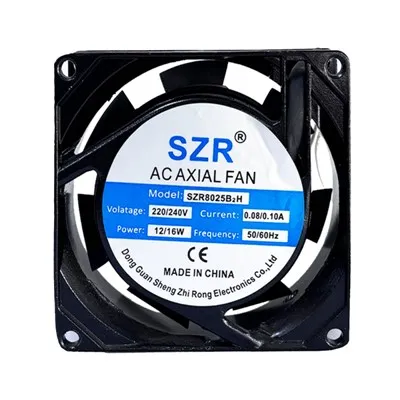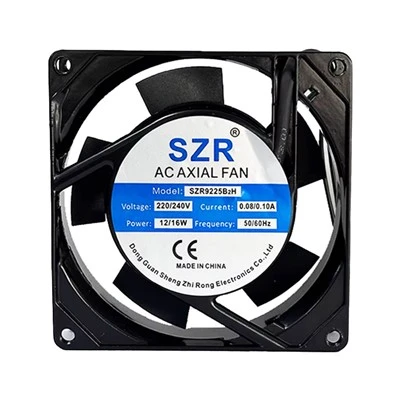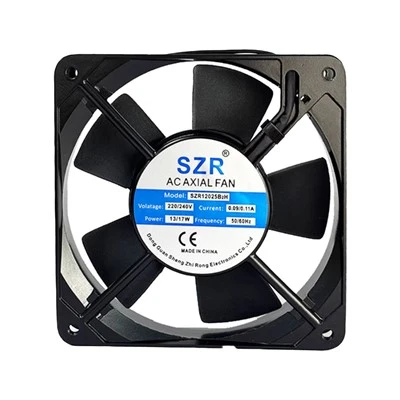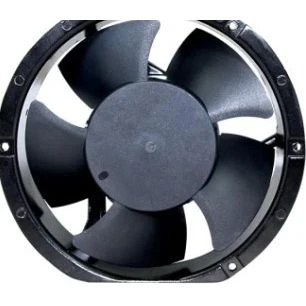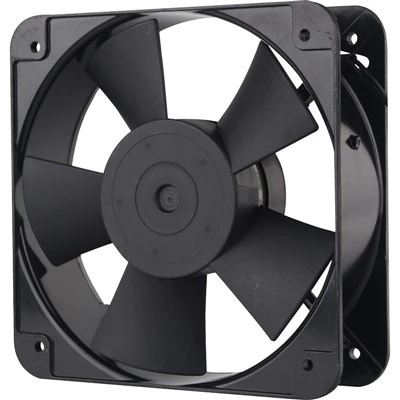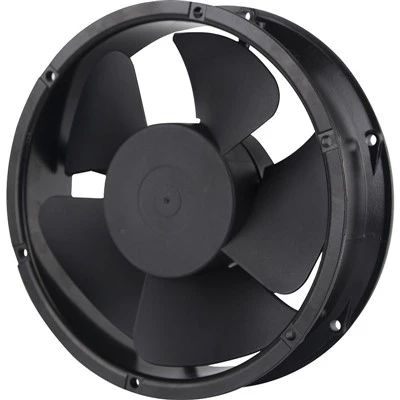
Centrifugal fans mainly consist of an impeller, casing, inlet, outlet, transmission assembly (motor and coupling), and bearing housing. These components work together to achieve the gas transport function.
Impeller: The impeller is the core component of a fan, consisting of blades, a rotor, and a shaft. The shape (forward-curved, backward-curved, radial) and number of blades directly affect the fan's air pressure and air volume. For example, backward-curved blades reduce airflow turbulence within the impeller, improving efficiency and reducing noise, making them suitable for applications with high energy consumption and noise requirements. Forward-curved blades generate higher air pressure but have relatively lower efficiency, often used in applications requiring high-pressure transmission.
Casing: The casing is typically made of welded or cast steel plates. Its function is to collect the gas discharged from the impeller and guide it to the outlet. The shape of the casing (spiral, volute) must match the impeller to reduce airflow resistance. For example, a volute casing, through a gradually widening flow channel design, converts the kinetic energy of the airflow at the impeller outlet into pressure energy, improving fan efficiency.
Inlet and Outlet: The inlet is located at the front end of the impeller. Its design must ensure that airflow enters the impeller evenly, reducing eddy current losses. The air outlet connects to the duct system; its angle and diameter need to be adjusted according to actual operating conditions to avoid efficiency loss due to airflow separation.
Transmission Assembly: The transmission assembly includes the motor, coupling, and pulleys (some models use direct-drive). The motor provides power, the coupling transmits torque, and the pulleys adjust the speed to adapt to different operating conditions. For example, a combination of a variable frequency motor and pulleys can achieve stepless adjustment of the fan's airflow.
Bearing Housing: The bearing housing supports the rotation of the impeller shaft and must possess high precision and wear resistance. Rolling or sliding bearings are typically used, and a lubrication system (such as oil bath lubrication or forced lubrication) is provided to extend service life.